.png)
When to Hire an External Facilitator for Your Leadership Retreat and When Not To

Most leadership teams don't spend enough time on this decision. They either default to an external facilitator because "that's what you do for a retreat," or they default to running it internally because it feels faster, cheaper, or more controllable. Both defaults are mistakes.
The decision matters more than most CEOs and Managing Partners realize. Get it wrong, and you compromise the retreat before it begins, not because the facilitator is "bad", but because the choice didn't match what the situation actually required.
This is a practical guide to making that call well.
Why the Decision Is Harder Than It Looks
On the surface, the question seems straightforward: do we have the internal capability to run this well, or do we need outside help? But that framing misses the real complexity.
The harder question is not (only) capability. It is role conflict. A member of your leadership team cannot simultaneously be a full participant in a high-stakes conversation and the person responsible for managing the process, tracking the dynamics, and intervening when things go sideways. Asking someone to do both is asking them to split their attention at precisely the moment when full presence matters most.
This is one of the core arguments for external facilitation, not expertise, but independence. An external facilitator has no stake in the outcome, no relationship to protect, no political position to hold. That independence is what creates the conditions for the team to engage fully.
But independence is not always what the situation requires. And external facilitation, done poorly or chosen for the wrong reasons, can create its own problems.
When an External Facilitator Is the Right Call
There are situations where internal facilitation is genuinely not viable, regardless of how skilled your people are.
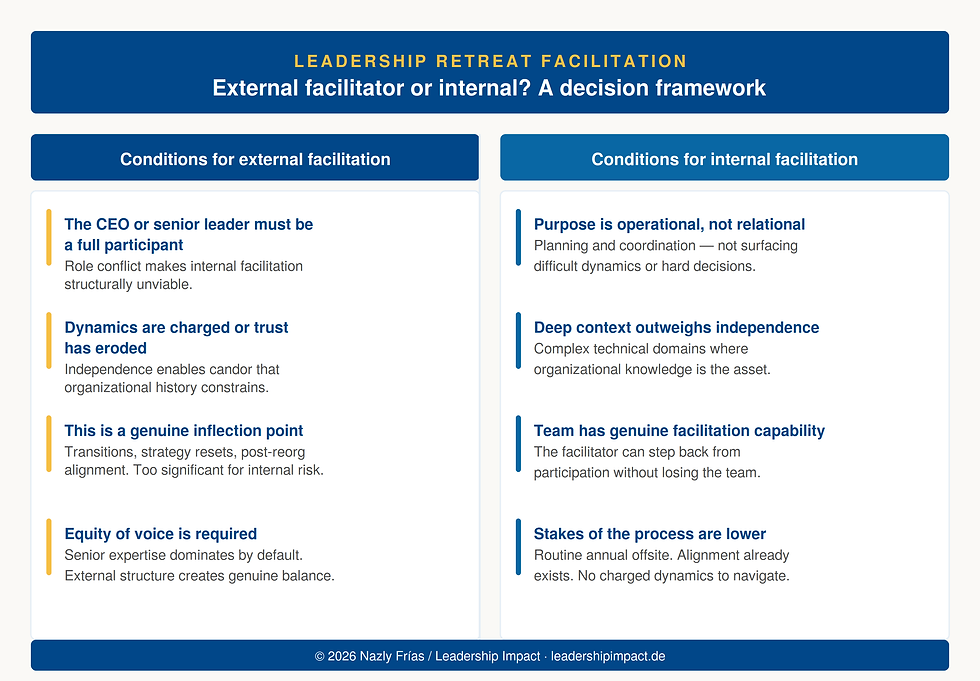
When the real issues involve the whole leadership team. If the CEO, Managing Partner, or Founder needs to be a full participant — not a process manager — the internal option collapses. This applies to almost every high-stakes retreat: strategy resets, trust repair, post-reorganization alignment, leadership transitions. These are not moments when the most senior person in the room should also be the one holding the space.
When the dynamics are charged. Unresolved tension between senior leaders, authority ambiguity, or a history of conversations that have been shut down before they reached the real issue. These conditions require a facilitator who can surface what is actually in the room without being implicated in it. An internal facilitator, however skilled, carries organizational history. That history constrains what they can name and how far they can push.
When candor requires structural protection. In expert-driven organizations and professional service firms, where authority is earned through expertise rather than hierarchy, the most senior voices often dominate by default. An external facilitator can design and hold a process that creates genuine equity of voice, something that is structurally harder to achieve when the facilitator is also a colleague.
When the retreat is a genuine inflection point. A routine annual offsite can often be run well internally. A retreat called because the organization is navigating a leadership transition, a strategy reset, or a period of significant fragmentation is a different kind of moment. The investment of leadership time is too significant, and the cost of a poor outcome too high, to treat it as a routine facilitation task.
When Internal Facilitation Makes Sense
External facilitation is not always the right answer, and it is not always worth the financial or relational cost.
When the team is genuinely aligned and the purpose is operational. If the retreat is primarily about planning, coordination, and shared information — not about surfacing difficult dynamics or making hard collective decisions — a skilled internal facilitator can run it effectively. The conditions for candor already exist, the stakes of the process itself are lower, and the familiarity of an internal facilitator with the team's context is an asset, not a liability.
When continuity and deep context are the priority. External facilitators bring independence. They do not bring the accumulated organizational knowledge of someone who has been inside the system. For certain retreats — particularly those focused on detailed strategic planning in complex, technical domains — that context matters more than the independence.
When the team has a strong facilitation culture. Some organizations have invested in facilitation capability at the leadership level. If members of your team genuinely have the skill to manage group dynamics, hold difficult conversations, and remain neutral under pressure, and if the retreat's purpose does not require their full participation as leaders, internal facilitation can work well.
The honest test is not "do we have someone who could do this?" It is "can that person be fully present as a participant and hold the process well at the same time?" If the answer is yes, only if they step back from participating, the cost may be higher than the savings.
What Most Organizations Get Wrong
The most common mistake is not choosing wrong. It is choosing for the wrong reasons.
External facilitation is chosen because it feels safer, more legitimate, or because there is an assumption that any competent external facilitator will handle the hard stuff. That assumption is wrong. The quality of external facilitation varies enormously, and a generic facilitator who runs a well-organized session but stays on the surface of the real dynamics is worse than a skilled internal leader who knows where the real issues are.
Internal facilitation is chosen because it is cheaper, faster to organize, or because the CEO wants to stay in control of the process. None of these are good reasons. The first two reflect under-investment in one of the highest-leverage uses of leadership time. The third is precisely the dynamic that external facilitation exists to interrupt.
The right question in both cases is the same: what does this team actually need to resolve, and what kind of facilitation creates the best conditions for that?
What to Look for If You Choose External
If the decision is to bring in an external facilitator, the selection criteria matter as much as the decision itself.
The strongest facilitators for senior leadership teams in expert-driven organizations are not defined by the frameworks they use or the number of retreats they have run. They are defined by what they can do in the room when things get heated or tricky, and they always do.
Specifically: can they work with power dynamics, not just agendas? Can they surface what is not being said without losing the room? Do they bring enough organizational and leadership understanding to recognize what is actually happening, not just what is being presented? And critically, do they design before they facilitate?
The diagnostic work before a retreat is where the real design happens. A facilitator who arrives with a pre-built agenda regardless of your specific situation is not actually doing the work.
For leadership teams in impact-driven, knowledge-intensive organizations — where authority is earned through expertise, where the team dynamic is often more complex than it appears, and where the stakes of getting it wrong are real — the right facilitator brings advisory depth alongside facilitation skill. The two are not the same thing, and finding someone who combines them well is rarer than the market suggests.
The Decision in Practice
When we work with executive and leadership teams preparing for a retreat, the first conversation is rarely about facilitation. It is about the situation, what is actually going on in the team and the organization, what the retreat needs to accomplish, and what conditions will make that possible.
The facilitation question follows from that. Sometimes the answer is external, sometimes internal, sometimes a hybrid where internal leaders own specific sessions and an external facilitator holds the overall process and the moments that require independence.
What does not work is treating the facilitation decision as a procurement choice. Selecting a facilitator based on availability, price, or reputation without a clear understanding of what the specific situation requires.
Leadership and Executive retreats are far too important for that.
About the Author
Nazly Frías is the founder of Leadership Impact, a boutique leadership advisory practice working with executive and leadership teams in expert-driven, purpose-oriented organizations.
She has designed and facilitated leadership retreats for senior teams across impact finance, sustainability advisory, policy consulting, and global development — and has herself led and served on leadership teams in complex organizational contexts across three continents.


Comments